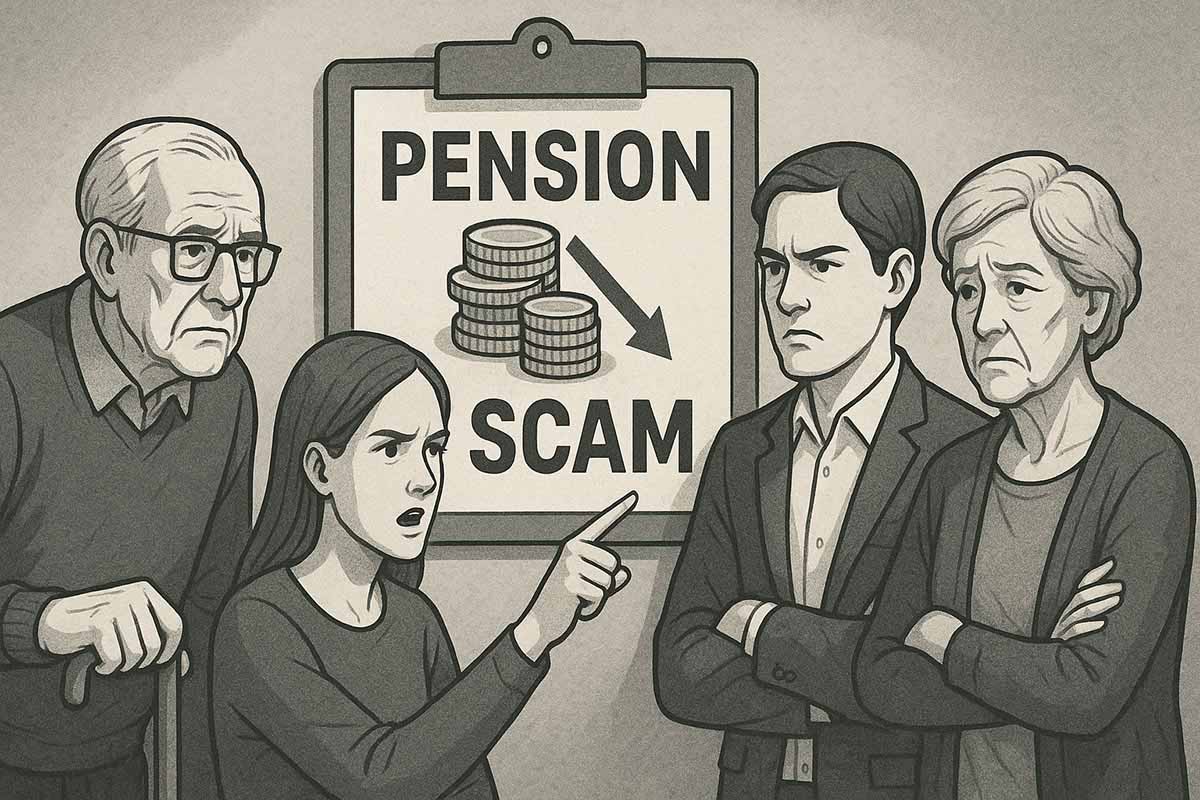
When a crisis arises – any crisis, whether a global economic downturn, a personal financial collapse, a family conflict or an emotional breakdown – fear inevitably rises within a person. It unfolds as if released, expanding and occupying the entire space of consciousness. In this state, fear behaves like an aggressive biological tissue. It grows without logic and without boundaries. It takes over behavior and reshapes one’s perception of reality.
If you examine it layer by layer, you see that the foundation of any fear is the fear of death. But death does not always mean the end of biological existence. It can be social, professional, emotional. Physical death is the ultimate scenario encoded in human biology. That is why fear of heights, enclosed spaces, depth, flying, speed – these are usually tied to a sense of physical threat. These reactions are ancient and recognizable.
Yet in the modern world, the overwhelming majority of fears originate socially. An economic crisis creates panic not because it threatens physical extinction, but because it undermines the social structures on which a person builds their existence. Losing a job, a sharp drop in income, the collapse of a familiar lifestyle – all of this is perceived as a threat of social death.
Social death manifests in several forms: losing a sense of one’s own importance, losing significance in the eyes of others, erosion of status, collapse of one’s usual role in the family or professional circle, inability to maintain the former level of communication, influence or dignity. These fears come in many varieties. A person may fear losing respect, attractiveness, professional stability, or becoming unnecessary in an environment where they once felt confident. Fear of judgment, fear of loneliness, fear of inadequacy – they are all variations of the same underlying mechanism.
In moments of crisis, a person confronts not only external circumstances but also the threat of inner disappearance. That is why the fear that arises during such periods often feels disproportionately strong: it reaches not individual situations, but the very structure of the “self.” Even a small disturbance can feel like a blow to the foundations of existence. In such moments, fear is not irrational – it simply protects what a person perceives as vital: their place, their role, their story.
At such times, people instinctively try to take control of the situation. Throughout my life, I have met very few individuals who did not attempt to control their life and circumstances. And this is natural. Under the influence of various fears, a person tries to control everything around them: children, family, a partner, work, money. Not only major decisions or turning points, but even the smallest everyday details – how objects are arranged on a shelf, how a career should develop, how the future of the family should unfold.
We try to control our time – every minute, every plan, every schedule. We try to control emotions – our own and those of others – to avoid conflict, disappointment or discomfort. We try to control perception: how we look, what others think of us, what impression we make. We control social media, our reputation, the decisions of friends and colleagues. We control the information we consume, the news we read and even the topics of conversation. We want to control our productivity, health, appearance, aging, mood, prospects, our children’s future, and the development of events that objectively do not depend on us.
We cling to control because it creates a feeling of safety in a reality that changes faster than we can adapt. Control becomes an internal support. It promises order where there is none and predictability where everything is uncertain.
But have you ever asked yourself what control actually is? In everyday understanding, it seems like a simple, almost technical concept: the ability to manage a process, predict outcomes and achieve the desired result. Control appears to be an instrument for imposing order – a way to keep life within boundaries so it does not collapse into chaos and randomness. We treat it as a necessary mechanism: if everything is considered, calculated and planned, we feel protected. In this sense, control is schedules, rules, instructions, stability, predictability. It is the line along which we guide events, people and ourselves so we do not lose direction. It feels material: pay more attention, take more steps, double-check – and order will follow.
In reality, however, control is nothing more than a psychological construct – an attempt to preserve a sense of safety where real management is impossible. Control is an internal mechanism that activates when certainty and clarity disappear, and its job is to compensate for anxiety when we do not understand what will happen next. It creates an illusion of stability in situations where, in fact, only a very small part is truly within our influence.
In other words, control is a psychological program designed to help us cope with the constant presence of chaos. This program activates instantly in response to uncertainty – a mental attempt to negotiate with reality by forcing it to follow our scenario. It is an internal survival strategy intended to provide a mental foundation, without which panic begins.
And what is panic? Essentially, it is the extreme form of fear. In a state of panic, a person stops relying on experience, knowledge and logic – or rather, these mechanisms simply stop functioning. Rational thinking gives way to a feeling of total helplessness, where one cannot act or even maintain a coherent thought. The body reacts faster than consciousness can engage: breathing becomes shallow, attention narrows, the body shifts into a primitive defensive mode. It is an instantaneous takeover of the psyche by physiology.
To prevent a person from turning into a terrified, non-functioning organism unable to understand what is happening, the psyche triggers a compensatory regime – control. An internal program is activated that attempts to break down any situation into understandable links of cause and effect. And as soon as even a minimal logical chain is constructed, the mind calms down: the unknown recedes, the puzzle forms a picture, and the person feels relief. There is a sense of: “Now I understand. And if I understand, I know how to act. And if I know how to act, then I am in control.”
At the same time, reality itself, in most cases, remains unclear, complex, and multilayered. Everything a person “builds” in their mind, trying to fit events into a simple cause-and-effect story, is merely an attempt to give chaos a shape. And almost always, this inner model has very little to do with what is actually happening. It is not a description of reality but the psyche’s attempt to defend itself from reality – to create a more comfortable version of events in which there is logic, culprits, sequence, and explanation. And the stronger the fear, the more a person needs the feeling of control, and the further this mental construct drifts from the true nature of what is happening.
This is where the real problem begins. Relying on their own interpretation of events – often incomplete, distorted, or entirely wrong – a person begins to shape their behavior. They construct an action plan based not on reality, but on an imagined scenario created in their mind, a scenario that feels logical and safe. Then they try to force the real situation to fit within the boundaries of that internal script, convinced that this is what preserves control. In practice, they only increase the gap between what is truly happening and what they are trying to control. In simpler terms, they make everything worse.
You’ve likely noticed this in your own life: the harder you try to keep everything under control, the heavier and more chaotic things become. At first, it seems that just a bit more effort, a bit more precision, a bit more vigilance – and the system will stabilize. But the opposite occurs. The tighter the internal fist clenches, the faster the outline starts to fall apart. Any deviation from the plan triggers a disproportionate reaction – irritation, anger, a sharp sense of helplessness. A small detail that once passed unnoticed suddenly becomes a blow to the nervous system. A plan that seemed logical and flawless yesterday collapses under the weight of unforeseen complications. Every new “not like this” feels like the world personally turning against you. These complications multiply, as if fed by your tension. They knock out your supports, break carefully constructed steps, and sometimes sweep away not only the plan but everything you have built over years.
A paradox emerges: the more a person strives for total control, the faster that control slips away. Logic suggests the opposite – that tension, discipline, and constant monitoring should create stability. But reality works differently. The reason is simple. The control you pursue so desperately is not a strength or a personality trait. It is an automatic psychic reaction to the unknown. When a person encounters something they cannot understand or predict, a protective program activates. Its only purpose is to create at least some foundation in the mind – a platform to stand on, a way to pull you out of paralysis to preserve your life.
Once this inner support appears, the psyche begins to build an action plan. This plan is always constructed from the knowledge and experience you already possess. Memory pulls in past situations, searches for patterns, compares events, trying to explain what is happening. All of this is an attempt to shrink the territory of the unknown. Unknowns are the primary source of fear. As mentioned earlier, at a biological level, all fear is fear of death – and what terrifies us most is the uncertainty of what lies beyond. We do not know what awaits on the other side of any major life change. We do not know how a crisis will end, what will follow the loss of a job, how a partner will behave, what a new stage of life will bring. As long as there is no clarity, the psyche treats the situation as a threat.
If a person possessed precise knowledge of what awaits them, fear would disappear. It is the absence of clarity that triggers the chain of defensive reactions. Control is one of them. It is an attempt to seal the hole created by the unknown.
Once understanding appears, fear diminishes. When clarity becomes complete, fear disappears. The psyche receives confirmation that there is no threat and stops mobilizing. This is why the need to control everything is not a character trait but a protective mechanism. It does not activate because you seek power, but because you seek comprehension. Unknowns frighten. Clarity soothes. Control is merely the bridge between the two states.
It is crucial to remember that your knowledge and experience do not allow you to see the full picture of reality. This is impossible. Any personal experience is a narrow fragment of an immense field of events. It is a drop in the ocean, and no accumulation of drops ever becomes the whole ocean or reveals what awaits within it.
Therefore, any plan you build based purely on your own understanding is limited from the start. It is not just imperfect – it is inevitably far from reality. As far as a stone axe is from a modern laptop. The plan exists only in your mind – nothing more. It is useful as a guideline, a way to reduce anxiety, but it can never become a precise map of the future.
And this leads to a natural conclusion: the more steps you try to fix in advance, the more detailed you try to make the future, the further this plan drifts from reality. Every additional step is a new hypothesis about how things “should” unfold. But the world doesn’t work like that. There are too many variables, too many factors you cannot access. The more complicated the plan, the lower the chance you will reach its execution – not because you lack strength or determination, but because an overloaded plan collapses at the first contact with real life.
And here, when you reach this point, the most unusual – almost mystical – moment begins. For the first time, you see clearly: you truly control nothing. Not because you “didn’t try hard enough,” not because you “don’t know how to manage life,” but because a human being is physically and mentally incapable of controlling everything. The scale of reality is simply incompatible with human capacities.
This is a fact that sooner or later must be acknowledged. And the act of acknowledging it becomes the turning point. As long as a person believes control is possible, they keep clenching their fists, wasting energy, constructing internal systems, and suffering from the fact that reality does not obey their mental models. But when the realization comes – that no one, neither you nor anyone else, is capable of controlling life at the level you wish – a natural question arises:
What, then, should I do?
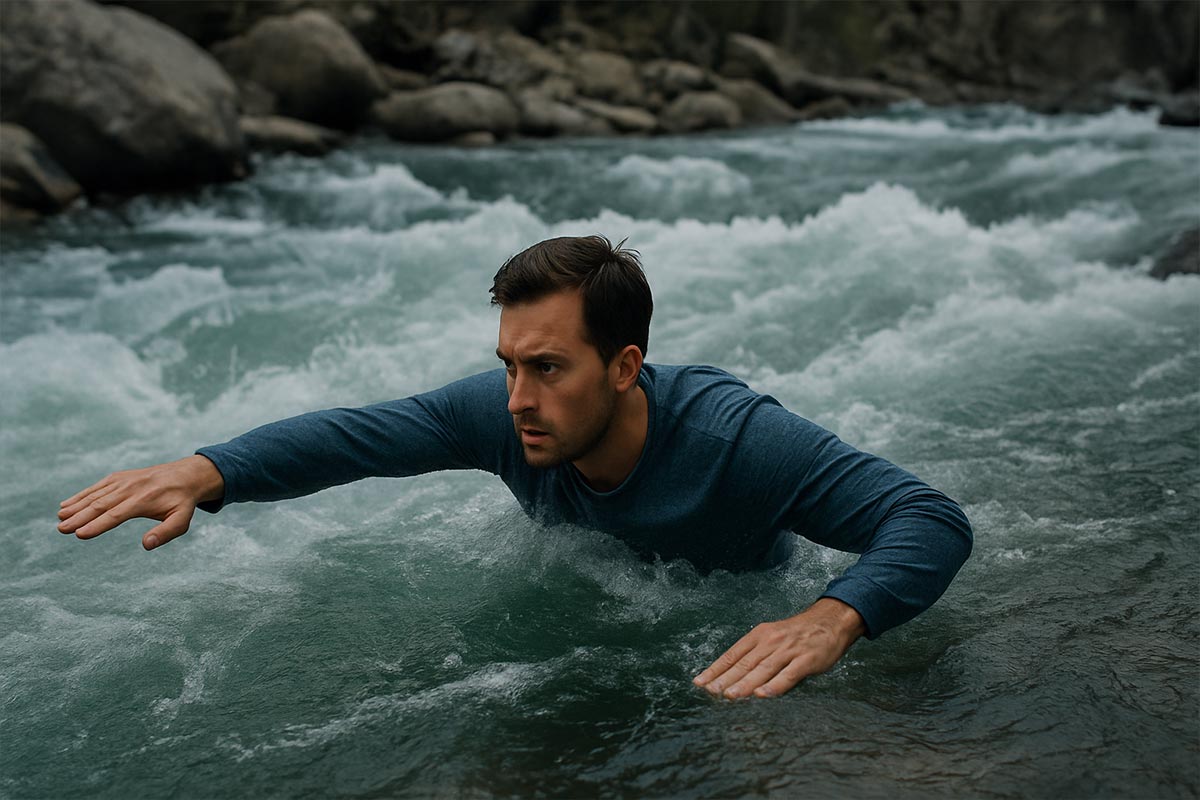
What are you supposed to do if you find yourself in a mountain river? In a river that is calm in some places and turbulent in others, you have no chance of changing its current. You cannot alter its course, cannot stop the flow, cannot force the water to move differently. And it is pointless to try.
But you can understand the essential thing: you are already in the river. It is carrying you. And the only rational choice is not to fight the current itself, but to work with the space that is available to you here and now. You do not plan “how to subdue the river.” You plan where to make your next stroke. You move your arms, push with your legs, and choose your direction according to the situation. You look ahead, note the rocks, assess the depth, decide where to shift and where it is safer to draw your line of movement.
This is the real plan – one stroke. Then the next. And then another.
When you stop trying to change what cannot be changed, your inner tension begins to dissolve. It doesn’t fade because things suddenly become easier, but because you finally stop wasting energy on the impossible. Your fists unclench. Your thoughts become clearer. And you start to see more – more opportunities, more turns, more space to maneuver. Energy returns, the very energy that used to be drained by fighting the unchangeable. Your next step becomes more confident. A sense of calm emerges because you finally understand: no one – neither you nor anyone else – can redirect the flow of life. You can only swim, avoiding the nearest obstacles and choosing the most reasonable direction available in the moment.
This is how life works. It is like this river: sometimes quiet and transparent, sometimes loud and forceful. And the only thing within your power is the next stroke. Nothing more.
It is here that a new paradox appears. At some point you notice that by abandoning total control, you suddenly gain a form of control that actually works. Real control is the ability to stroke confidently, not the ability to alter the current. Therefore, only one task remains – keep stroking, look ahead, and make the next deliberate, simple, conscious movement.
From this follows a simple conclusion: a human being lives in a world whose scale is immeasurably greater than their capabilities. We face crises – external and internal – and each time we feel fear rising. It appears for a reason. At the deepest level, all fear is tied to the unknown, and the unknown is tied to our inability to control the future, circumstances, or the turning of life’s current. This drives us to construct elaborate plans, to hold on tightly, to try to prevent every possible deviation in advance. But the tighter we try to grip the world, the faster it slips away. Any excess of control turns into its opposite – loss of stability. Tension increases, plans collapse, strength evaporates, and a person ends up defeated not by the crisis itself, but by the struggle against the impossible.
Our knowledge and experience are only a drop in the ocean of reality. No plan can account for everything that is unfolding. It exists only in the mind and inevitably diverges from real events. The more we try to detail the plan, the further it drifts from reality, and the more likely it is to crumble at the first encounter with life as it truly is.
The real turning point comes when a person recognizes: control is impossible in the form they try to impose. The thought seems frightening, but it is this realization that sets you free. Once you accept that you cannot manage everything, you finally begin to see what you can manage. This is the turning point – the “threshold of clarity.” You understand: life is a river. Its current cannot be changed, but you can move within it – step by step, stroke by stroke. Not by trying to shift the riverbed, not by fighting a force far greater than yourself, but by using the part of the flow that is available to you.
Then the pointless tension disappears. Calm arrives. Energy returns. Each next step becomes more precise. You do not know what will happen in a month or a year, but you know where to make your next stroke – and that is enough.
And here is the main conclusion: the point is not to control life, but to inhabit it. Not to change its current, but to make the next step confidently and consciously. And this is the paradox of real control. When you stop fighting what cannot be changed, you finally gain power over what can be – the direction of your own movement.
This is the place where fear fades, chaos retreats, clarity appears, and mature, steady, strong life begins.